What Is the PGST Wireless Home Alarm System?
Founded in 2011, PGST has served more than 50 million households worldwide, with a stated mission of making communities safer through cost-effective, reliable products. That's not a small company. That's not a startup trying to disrupt something. That's a manufacturer that has spent over a decade refining a product category most people find deeply frustrating.
The PGST A107F — also marketed under variations like the PG105 and PG108 — is a wireless, WiFi-enabled home alarm hub that pairs with a growing ecosystem of sensors, detectors, and accessories. The system integrates with the Smart Life or Tuya app, allowing remote access and control directly from a smartphone. The core premise is simple: you buy the kit, you install it yourself in under 15 minutes, and you never pay another dime to keep it working.
There are no hidden fees or subscription costs — once you've purchased the system, all features are yours to use indefinitely. In a market where SimpliSafe starts at $19.99/month and ADT can run upward of $60/month, that's a meaningful differentiator.
Inside the Box — What You Actually Get
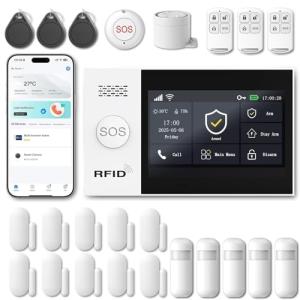
The PGST system ships in several kit configurations depending on which variant you purchase. The listing at Amazon (B0DZCW18YK) represents one of the more comprehensive bundles. Across the product line, a standard kit typically includes:
- 1 central alarm hub/panel — the brain of the operation, with a built-in keypad and speaker
- Door and window contact sensors — magnetic sensors that trigger when opened
- PIR infrared motion detectors — for hallways, living rooms, and open spaces
- Remote controls — handheld key fobs for arming and disarming
- SOS button — for emergency alerts
The system supports up to 100 wireless storage locations for pairing accessories such as motion detectors, door sensors, outdoor sirens, and more. That's a genuinely impressive ceiling. Most starter-level security systems cap out at 10–15 devices. PGST gives you room to grow from a studio apartment all the way up to a five-bedroom home without ever hitting a hard limit.
DIY Installation — The Real Story
Let's be direct about something: most DIY security system guides undersell the effort involved. The PGST system is genuinely one of the easier setups on the market, but "10 minutes" assumes you've already downloaded the app, have your WiFi password ready, and are comfortable with basic adhesive mounting. That said, PGST's home alarm system can be set up in approximately 10 minutes using just the included screws, with no professional help required.
Here's the general flow:
Step 1: Download the Smart Life or Tuya app on iOS or Android.
Step 2: Plug in the main hub via the included micro-USB power adapter.
Step 3: Connect the hub to your 2.4GHz WiFi network through the app. Note: the system only supports 2.4GHz WiFi and is not compatible with 5GHz networks. This trips up a lot of first-time users who have newer dual-band routers defaulting to 5GHz. Check your router settings before setup.
Step 4: Pair each sensor to the hub — this takes about 30 seconds per device.
Step 5: Mount sensors using adhesive strips or screws, depending on your surface.
The motion detectors use passive infrared (PIR) technology, equipped with ultra-sensitive infrared detection and anti-interference technology for reliable performance with low power consumption, which means excellent battery life without compromising on sensitivity.
For families with mixed tech literacy, the keypad interface supports multiple languages. The PG107 home alarm supports 9 languages including English, German, Russian, Spanish, Polish, Italian, French, Portuguese, and Chinese. That's a detail that matters enormously in multilingual households or for elderly family members more comfortable in their native language.
App Control and Smart Home Integration
The Smart Life and Tuya apps are among the most widely deployed smart home platforms in the world, which works strongly in PGST's favor. From the app, you can remotely control and set parameters for your alarm system, customize alarm modes, receive instant push notifications, and sync all your alarm devices.
The system supports multi-channel alarm modes including app push, SMS, and voice monitoring, with the ability to preset up to five groups of phone numbers and SMS numbers that can be individually enabled or disabled. This is practical thinking. Maybe you want your partner to get a call but only an SMS, while your neighbor just gets a push notification. PGST handles that granularity.
The system is also compatible with Amazon Alexa and Google Assistant, allowing you to arm or disarm with a single voice command. For anyone who has built out a smart home with Echo devices or Google Nest speakers, the PGST system slots in cleanly.
You can also share the PGST home security system with family members via email or phone number through the Smart Life app, which means multiple people can monitor and control the system without needing to share login credentials.
The 120dB Siren — Louder Than You Think
Let's talk about the alarm itself. When motion is detected, your phone receives instant push alerts, and an alarm sounds at up to 120dB. For context, 120dB is roughly equivalent to a chainsaw at close range or a live rock concert at the front of the pit. It is, without question, loud enough to wake up neighbors and deter most opportunistic intruders.
The psychological deterrent effect of a loud siren should not be underestimated. Most residential burglaries are crimes of opportunity — a door that looks easy, a window that's slightly ajar, no obvious signs of security. A 120dB siren removes all ambiguity. It announces, loudly and clearly, that this house is watched.
The hub also functions as a two-way intercom. You can arm/disarm, monitor via voice, and use the intercom function all from your cellphone. The ability to speak through your alarm panel from anywhere in the world is a feature you typically find on systems costing three or four times as much.
The SOS Button — Security for Every Generation
This is the feature that often gets overlooked in tech-focused reviews, but it may be the most important one for families.
For families with children, the smart home alarms can be set to alert parents when kids open exterior doors. Additionally, the SOS button is designed to be accessible for elderly users who may need immediate help.
In emergencies, pressing the SOS button immediately contacts pre-set contacts — whether family members or neighbors — ensuring that assistance arrives promptly.
Think about what that means in practice. A grandparent living alone in a house on Maple Street in Des Moines doesn't need to navigate an app, find their phone, or remember a PIN. They press one large, obvious button and help is on the way. A child home alone after school can trigger an immediate alert to both parents with a single press. That kind of accessibility-first design is rare in consumer security hardware.
4G GSM Backup — When WiFi Isn't Enough
One of the strongest selling points of the higher-tier PGST configurations is dual-connectivity. PGST's system stands out with its 4G cellular connectivity, ensuring alerts reach your phone even if WiFi fails.
This matters more than most people realize. WiFi-only alarm systems have a fundamental vulnerability: if a sophisticated intruder cuts your internet connection — or if your router just goes offline during a power outage — your entire security system goes dark. A 4G GSM SIM card slot eliminates that single point of failure.
After inserting a SIM card and completing setup, you can receive reminder calls and SMS messages when the system is triggered. The SIM card is not included, but a standard prepaid SIM from any carrier works. In the US, a T-Mobile or AT&T prepaid SIM card costs less than $10 and can be set to data-only mode for minimal ongoing cost.
PGST vs. the Competition — Comparison Table
Before spending money on any home security system, it's worth understanding how the major players stack up. Here's a straight, side-by-side comparison across the categories that actually matter.
| Feature | PGST A107F (B0DZCW18YK) | SimpliSafe (Gen 3) | Ring Alarm (5-Piece) | KERUI W181 |
|---|---|---|---|---|
| Monthly Fee | None | $19.99–$27.99/mo | $10–$20/mo | None |
| Professional Monitoring | No (self-monitored) | Optional | Optional | No |
| WiFi Connectivity | Yes (2.4GHz) | Yes | Yes | No (RF only) |
| 4G/GSM Backup | Yes (SIM slot) | Via add-on ($) | Via add-on ($) | No |
| Max Sensor Count | 100 | 100 | 100+ | 30 |
| Alexa/Google Compatible | Yes | Yes | Yes | No |
| DIY Installation | Yes (~10 min) | Yes (~30 min) | Yes (~20 min) | Yes (~15 min) |
| App Control | Smart Life / Tuya | SimpliSafe App | Ring App | No app |
| SOS Button Included | Yes | No (add-on) | No | No |
| Siren Volume | 120dB | 95dB | 104dB | 115dB |
| Multi-language Support | Yes (9 languages) | English only | English only | Limited |
| Approx. Entry Price | ~$70–$90 | ~$249 | ~$199 | ~$45 |
| Subscription Required | Never | Optional | Optional | Never |
The numbers tell an honest story. PGST is not the cheapest option, but it is comfortably the most full-featured system in its price tier without any subscription requirement. SimpliSafe and Ring both offer professional monitoring options — a genuine advantage for users who want a human response layer — but that service comes at a recurring monthly cost that adds up fast. Over three years, a SimpliSafe monitoring plan costs between $720 and $1,008 in subscription fees alone, on top of the hardware purchase price.
Who Is This System Actually Built For?
Being honest about product fit is more useful than generic praise. The PGST Wireless Home Alarm System is an excellent choice for:
Homeowners and renters in mid-sized homes. Whether you're in a craftsman bungalow in Portland, Oregon, or a townhouse in Charlotte, North Carolina, the sensor capacity and range handle most residential layouts with ease.
Families with elderly parents or young children. The SOS button and multi-contact alert system are genuinely life-safety features, not marketing bullet points.
Tech-comfortable users who want control. If you already use Alexa, have a smart home setup, or enjoy customizing your devices, the Tuya ecosystem gives you deep configuration options.
Budget-conscious homeowners who refuse subscription fees. The math is simple: a $90 upfront investment versus $240+ per year in monitoring fees. Over five years, the PGST system could save you over $1,000.
Multilingual households. Nine language options across app interface, voice instructions, and SMS notifications make this one of the most accessible systems for non-English-speaking households.
It may not be the right fit for:
Users who want 24/7 professional dispatch monitoring. There's no human on the other end of a PGST alert. You are your own monitoring center.
Those in large properties or commercial spaces. A 100-device ceiling is generous for residential use, but a large property or small business may require a more scalable commercial system.
Strictly 5GHz WiFi environments. If your router doesn't broadcast on 2.4GHz, the system won't connect without a network adjustment.
Real-World Placement Strategy — Sensors Where They Count
Getting the most out of any alarm system is less about how many sensors you have and more about where you put them. Here's a practical room-by-room guide:
Front door: Always the first priority. The majority of home break-ins in the United States occur through the front door. A door contact sensor here is non-negotiable.
Back door and sliding glass doors: Second and third priority. The wireless door sensor has a transmission distance of 80 meters to the central panel, so even outbuildings or detached garages are reachable.
Ground floor windows: Particularly those not visible from the street. Basement windows are a frequent entry point in homes across Chicago, Illinois and Minneapolis, Minnesota, where lower-level access is common in older housing stock.
Main hallway: A PIR motion detector in the primary interior hallway creates a catch-all layer. Anyone who gets past entry-point sensors will trigger the hallway detector.
Staircase: In multi-story homes, a motion detector at the bottom or top of the staircase ensures that movement between floors doesn't go undetected.
Children's rooms: When used on a dog door or cat door, sensors can detect in real time if a pet has left the house — the same logic applies to monitoring children's access points.
Battery Life and Maintenance
One of the practical concerns with any wireless sensor system is battery lifespan. Dead batteries mean blind spots.
PGST sensors use ultra-low power chips that provide excellent battery life, and the app notifies you when individual sensors are running low. Most users report battery changes needed roughly once every 12–18 months under normal use conditions, though this varies depending on trigger frequency and ambient temperature.
The hub itself runs on corded power via micro-USB. The corded electric power source may limit placement options and require proximity to outlets — a legitimate consideration when deciding where to mount the main panel. However, higher-tier PGST models include a built-in backup battery that maintains operation during short power outages.
One Year Warranty and Customer Support
The PGST system comes with a 1-year warranty that provides reassurance and customer support. PGST also maintains an operation video library accessible from their Amazon storefront, which covers setup scenarios that the written manual doesn't fully address. For first-time alarm system users, those video tutorials are worth watching before starting installation.
Customer service has been a consistent point of feedback in user reviews across the Amazon listings. PGST responds to product questions directly through the Amazon seller interface, and the Tuya/Smart Life ecosystem has active community support forums for troubleshooting connectivity issues.
The Bigger Picture — Why DIY Security Is Having a Moment
The professional alarm industry in the United States is undergoing a genuine reckoning. Major monitoring companies like ADT — headquartered at 1501 Yamato Road, Boca Raton, Florida 33431 — still dominate the market in terms of installed base. But the fastest-growing segment of the residential security market is self-monitored, no-contract systems. The reasons are both economic and cultural.
Economically, the math stopped working for a lot of homeowners. After inflation, the idea of adding another $25/month subscription to an already subscription-heavy budget is a harder sell than it was five years ago.
Culturally, the smartphone generation is comfortable with remote monitoring. They already watch their kids via Nest cameras, track their dogs via GPS, and check their thermostats from the airport. Adding a PGST alarm to that ecosystem is not a leap — it's a natural extension.
The beauty of the PGST system lies in its no-frills approach: no hidden costs, no monthly fees, just straightforward ownership that allows you to take charge of your home's security without the stress of recurring charges.
Does the PGST Wireless Home Alarm System Deliver?
The short answer: yes, with caveats.
The PGST Wireless Home Alarm System with DIY Sensors does what it promises. It installs quickly, it connects reliably (on 2.4GHz WiFi), it sends alerts fast, and it scales from a one-bedroom apartment to a five-bedroom home without breaking the bank. The 120dB siren, the SOS functionality, the 4G GSM fallback, and the Alexa/Google integration are features you'd expect from a system costing twice as much.
The caveats are real but manageable. You are your own monitoring station. There is no professional response team. The 5GHz WiFi incompatibility requires a router check before purchase. The corded hub needs an outlet nearby.
But for the homeowner who wants genuine, functional, customizable protection — without handing $300 per year to a monitoring company indefinitely — this system is among the strongest arguments for taking home security into your own hands.
View the PGST Wireless Home Alarm System on Amazon →